
On this page
About the Book
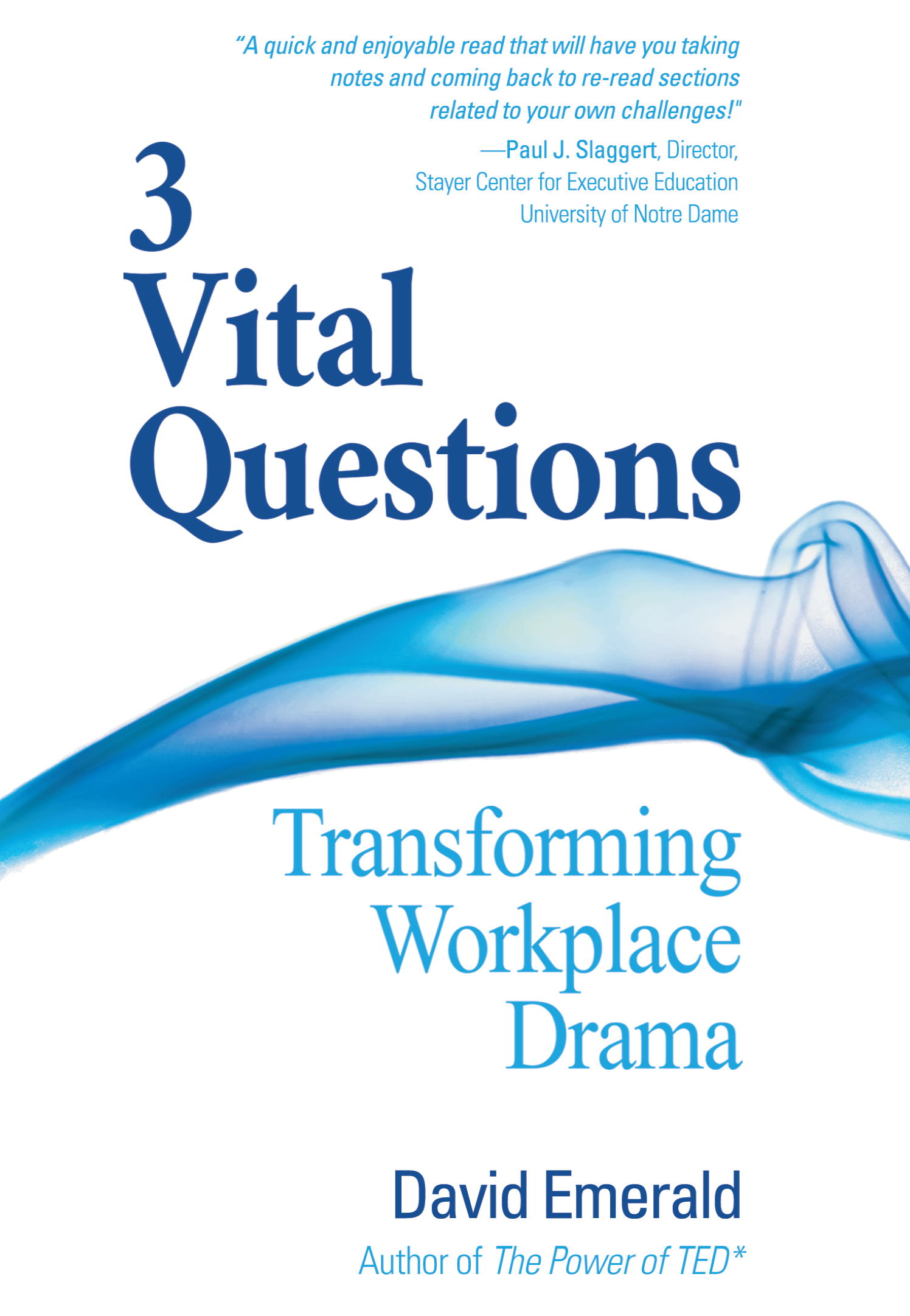
Most organizations spend their energy on products, systems and structures. This book is about the part that decides whether those efforts work: how people think, relate and act with one another. David Emerald distills The Empowerment Dynamic into three vital questions that a leader, a manager or a whole team can ask every day.
| Detail | Information |
|---|---|
| Title | 3 Vital Questions: Transforming Workplace Drama |
| Author | David Emerald (David Emerald Womeldorff) |
| Publisher | Polaris Publishing, March 26, 2019 |
| Length | 226 pages, paperback |
| Formats | Paperback and eBook |
| ISBN-13 / ISBN-10 | 9780996871839 / 0996871837 |
| Recognition | Distinguished Favorite, 2020 NYC Big Book Award; Distinguished Favorite, 2020 Independent Press Award; Finalist, 2019 Indie Book Awards (Careers) |
What Is the Book About?
The book builds on The Power of TED*, which introduced the Empowerment Triangle of Creator, Challenger and Coach. Like the Center’s other books on The Empowerment Dynamic, it teaches through a fable, so the ideas arrive through characters and situations that readers will recognize from their own workplaces.
The book’s subject is the human side of work. The Center’s change leadership brief, which draws on the book, frames it with a model adapted from Peter Senge that describes three dimensions of work:
| Dimension | Focus |
|---|---|
| A. Production and delivery | Producing and delivering the organization’s products and services |
| B. Design and implementation | Designing and implementing systems, processes and structures |
| C. Thinking, interacting and acting | Thinking about how we think, interact and take action: the human dimension, where change leadership takes place |
According to the brief, many organizations focus on dimensions A and B, and a primary cause of ineffective change efforts is that they do not consciously engage in the C dimension.
When it comes to leadership (and change), it is the soft stuff that’s hard.
The three questions are the tool for working in the C dimension. For a guide to the framework itself, read The 3 Vital Questions. The book is where you will find the full story, written for people who want to bring the questions to their own teams.
Three Core Concepts
Question 1 · Focus
Problem or outcome orientation?
People default to a problem orientation, which drives reactive behavior. An outcome orientation focuses on what you want to create, and tends to bring engagement and lasting change.
Question 2 · Relating
Drama or empowerment?
The problem orientation fosters the Victim, Persecutor and Rescuer roles of the Dreaded Drama Triangle. The outcome orientation opens the way to relate as Creator, Challenger and Coach.
Question 3 · Action
Reacting or creating?
Actions can merely react to the problems of the day, or generate outcomes. Baby Steps and a Dynamic Tension planning process give momentum toward what you want.
The framework behind these concepts is explained step by step on the 3 Vital Questions guide. The book brings it into a story you can share with a team.
What You’ll Learn
Skills the 3 Vital Questions framework builds
- Recognize whether you, your team or your organization is operating from a problem orientation or an outcome orientation, and how to shift.
- Spot the Victim, Persecutor and Rescuer roles in everyday workplace interactions, and respond as a Creator, Challenger or Coach.
- Use Dynamic Tension and Baby Steps to keep a team moving toward an outcome without waiting for perfect conditions.
- Build a shared language and set of expectations so people can call out drama with respect and without blame.
- Include the human dimension in change efforts, rather than leaving it to chance.
Who Should Read This Book?
Leaders
Executives and team leaders
If you set culture by what you pay attention to and how you respond under pressure, the questions give you a way to lead with intention.
Managers and HR
People managers, HR and talent leaders
For anyone who spends time on conflict, disengagement or turnover, the book offers a common language that managers can use right away.
Executive coaches
Coaches who work inside organizations
The three questions give a coach a simple frame for conversations with leaders, and a way to coach the culture as well as the individual.
OD practitioners
Organization development and change practitioners
The human dimension of change is where many programs falter. The book gives you a vocabulary to bring it into planning.
Applying the Questions in Real Organizations
These results come from the Center’s published success stories, not from the book.
Cleveland Clinic
Engagement at a 50,000-person health system
The Clinic’s five-month Engagement Leadership Series, which uses TED* and the 3 Vital Questions, has reached more than 1,000 leaders. Of the participants identified for improvement, 80% raised their scores on the next survey.
Read the Cleveland Clinic storyStudio Movie Grill
Turnover that fell as the company grew
Management turnover fell from 42% to 18% over three years, saving more than $1 million annually, and the company is trending toward 80% internal hires.
Read the Studio Movie Grill storyShouldn’t we be asking these 3 questions every day?
I’ve found none as helpful and practical as those in David Emerald’s The Power of TED* and his new book 3 Vital Questions. It is a vital read for any leader looking to inspire breakthrough change throughout their organization.
See more in the success stories library and the Center’s brief 3 Vital Questions: A Foundation for Change Leadership.
Frequently asked questions
Is 3 Vital Questions a sequel to The Power of TED*?
It builds on The Power of TED* by applying The Empowerment Dynamic to work. The Center treats the two books as the foundation for the 3 Vital Questions framework. Both are fables, and each can be read on its own.
Do I need to read The Power of TED* first?
It is not required, but we suggest starting with The Power of TED* if you are new to the Empowerment Triangle, since the 3 Vital Questions build on its three roles. If workplace drama is your pressing problem, you can begin here and use the Empowerment Triangle guide for the basics.
Is the book only for businesses?
No. The book is written for the workplace, and that includes nonprofits, health systems and government agencies, such as Nevada County DSS. The questions also work at home. The 3 Vital Questions guide explains how.
Is there a training program for the 3 Vital Questions?
Yes. The 3 Vital Questions eCourse is a self-paced online course, and the TED* Practitioner Certification prepares facilitators and coaches to teach TED* in organizations.