
On this page
About the Workbook
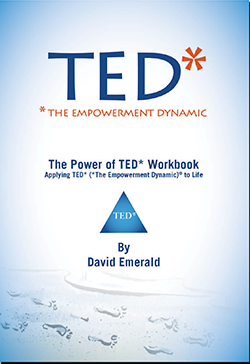
A story can change how you see a problem, but a habit changes only with practice. The Power of TED* tells the story of leaving drama behind. The workbook is where you do it yourself. It is a practical companion that helps you apply The Empowerment Dynamic to your own relationships, work and decisions.
| Detail | Information |
|---|---|
| Title | The Power of TED* Workbook: Applying TED* (*The Empowerment Dynamic)® to Life |
| Author | David Emerald |
| Companion to | The Power of TED* |
| Focus | The roles of Creator, Challenger and Coach, and new habits of thinking and relating |
| Format | Print and digital copies, sold by the Center for The Empowerment Dynamic |
What’s Inside the Workbook
The Center describes the workbook as a set of guided exercises, reflections and tools. Together they are meant to deepen your understanding of the three roles of the Empowerment Triangle and to help you replace old reactive habits with new ones.
Guided exercises
Practice in your own situations
Exercises take the ideas of the book out of the story and into your life, so you can try the Creator, Challenger and Coach roles with real people and real choices.
Reflections
Notice your patterns
Reflection prompts slow you down long enough to see which role you are in, what you are focusing on and what you actually want.
Tools
Keep a reference close
Tools give you a quick way to check your focus, your relating and your next action when the pressure is on.
How the Workbook Complements the Book
The book and the workbook do different jobs. The book helps you understand the model through a story. The workbook helps you apply it to your own life. Used together, each reading becomes a short cycle of understanding, reflection and action.
| Aspect | The Power of TED* (book) | The Power of TED* Workbook |
|---|---|---|
| Form | A teaching fable | Guided exercises, reflections and tools |
| Main purpose | Understand the model through a story | Apply the model to your own life |
| Strongest at | Giving you shared language and a picture of the shift | Turning insight into habits |
| Best used | First, or alongside the workbook | After or alongside the book |
| Option | What you get | Best for |
|---|---|---|
| The Power of TED* | The fable and the model | Readers new to TED* |
| The Workbook | Guided practice | Readers who already know the model or are reading the book |
| Book + Workbook combo | Both, in one purchase from the Center | Anyone who wants to read and practice together |
| Digital Workbook | The workbook in digital form | Readers who prefer to work on screen |
- 1
Read
Read a section of the story and notice where David’s focus or role shifts.
- 2
Reflect
Pause and write down which role you recognize in yourself and what outcome you want.
- 3
Practice
Choose one Baby Step, do it and note what changed.
Who Is the Workbook For?
Individuals
Readers practicing on their own
If you finished The Power of TED* and want to make it stick, the workbook gives you a structure for doing so at your own pace.
Coaching clients
People working with a coach
Reflection exercises can be a between-session practice. A coach can use them to prompt conversation, and clients can use them to keep the work going.
Groups and facilitators
Teams, book groups and classes
A shared set of exercises gives a group common language. Facilitators can choose an exercise, give people time to write and then debrief together.
If you coach professionally, the TED* Advanced Coaching course and the practitioner certification go further into applying TED* with clients.
Preview the Workbook
Official sample pages are not published online. This sample-style exercise, written for this page, shows the kind of practice TED* invites. You can do it on paper in about ten minutes with one real situation in mind.
Sample-style exercise: from stuck to Baby Step
Think of a situation where you feel stuck, frustrated or reactive. Write short answers to each prompt.
- Describe the situation in two sentences. Stick to what happened and leave out the story about whose fault it is.
- Which role are you in: Victim, Persecutor or Rescuer? What thoughts, feelings and behaviors tell you so?
- State what you want in this situation as an outcome, in positive terms. It can be vague and directional.
- Which empowering role could you step into: Creator, Challenger or Coach? What would that look like in this situation?
- Write one Baby Step: something that is 100% your responsibility, short-term and actionable. When will you do it?
This exercise was written for this page and is not part of the workbook.
Free download
Transform Drama Into Empowerment field guide
A one-page overview of the three shifts, the six roles and the three questions, from the Center.
Download the field guide (PDF)Free tool
Empowered Trust Reflection Tool
A free tool from the Center: choose a relationship you want to strengthen, reflect on trust and take one Baby Step.
Try the Trust Reflection ToolFrequently asked questions
Do I need to read The Power of TED* before using the workbook?
We recommend reading the book first or alongside the workbook, because the exercises build on the roles and ideas the story introduces. If you want to start practicing right away, the free field guide gives you the basics on one page.
Can I use the workbook independently?
It is designed as a companion, so it works best with some familiarity with the Empowerment Triangle. If you already know the model from the Empowerment Triangle guide or from training, you can use the workbook without rereading the book.
Is there a digital version of the workbook?
Yes. The Center sells a digital copy of the workbook as well as the print edition.
Can coaches use the workbook with clients?
Yes. The reflections and exercises can be a practice between sessions, and a coach can use them to start a conversation. For coaching training, see the TED* Advanced Coaching course.