Why Baby Steps Work
How Baby Steps are the Secret to Creating Anything In my last blog I wrote about how to leverage the energy in the gap between what you want and what you actually have. I challenged readers to view this energy as…
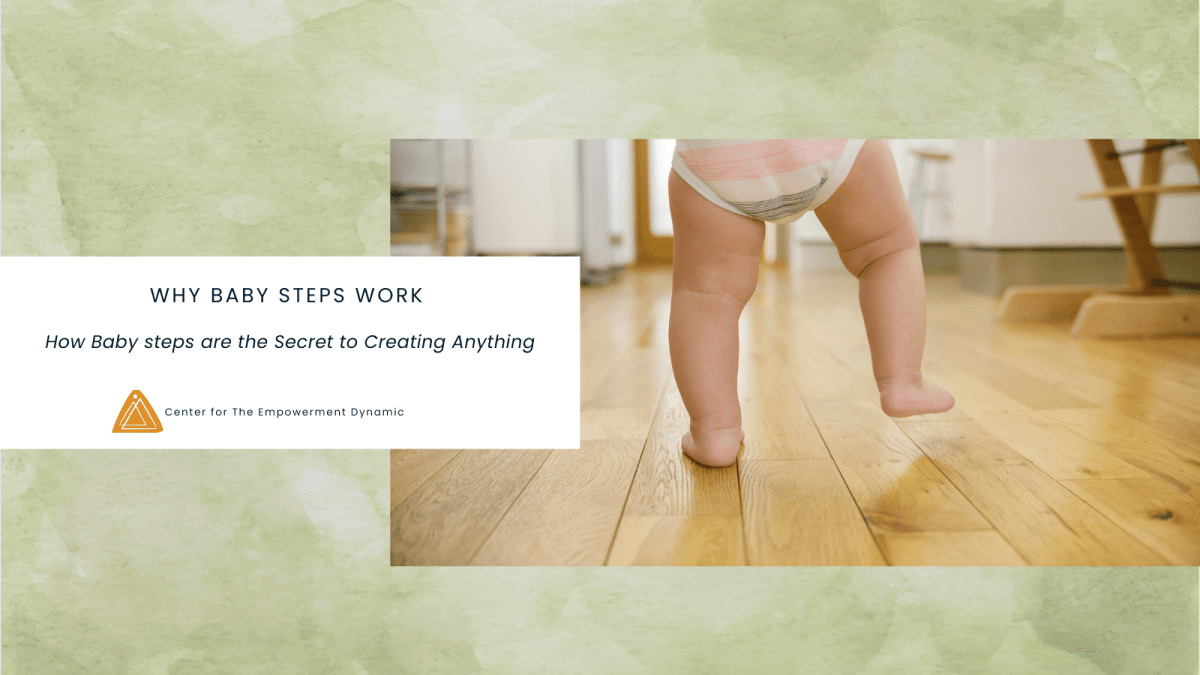
How Baby Steps are the Secret to Creating Anything
In my last blog I wrote about how to leverage the energy in the gap between what you want and what you actually have. I challenged readers to view this energy as generative rather than as anxiety. When embracing this energy as generative, the next step in the creating process is to get going – to get into action.
How do your creative thoughts become reality? How do you move beyond procrastination and get into action?
For an idea to grow, you must build momentum and move forward in some direction. But how can that be accomplished?
When I ask myself that question, I hear David’s voice. He often said that what we want is usually “vague and directional.” In other words, we may have an inkling, a rough idea, or a felt sense that something is wanting to come forward.
If our egoic mind tries to force, push, or control this “vague and directional” feeling too quickly or before its time, the tension between what we want and what we actually have can become constrictive and pressured. Here are just a few derailing thoughts that often arise:
- I must have everything figured out before I begin.
- The whole idea seems too big. I get overwhelmed thinking about all the details.
- I don’t want to make a mistake, so it’s better to do nothing.
- Other people know how to do it better than I do.
Each of these statements is rooted in the Dreaded Drama Triangle (DDT). In one way or another, all three DDT roles show up: persecuting oneself for not having it all figured out, feeling like a Victim to one’s own big ideas, or hoping for a Rescuer who knows better and will get us where we want to go.
Baby steps are a remedy for all of these disempowering and reactive thoughts! Baby steps are defined as 100% your responsibility to do and are short-term and actionable. This puts the responsibility on your shoulders to get into action, which reinforces the Creator role in TED* (*The Empowerment Dynamic)®.
The idea of taking baby steps is a core concept in the TED* framework and is based on the principle that creating is an ongoing, incremental process toward a vague and directional desire. For many, a baby step simply means taking the next step. The magic lies in choosing the small step that is yours to take, not someone else’s. That is, in itself, an act of personal empowerment.
Here are five important ways baby steps can help you get unstuck and into action—even if you’re not quite sure where you're heading:
- Prevent brain overload.You wouldn’t go to the gym and try to lift 300 pounds on the first day. Your muscles can’t take the overload—and neither can your brain. Baby steps allow your mind to focus on one action at a time, reducing overwhelm. And you’re less likely to lie awake at night worrying about every detail.
- Protect against the fear of making mistakes.To guarantee success, your ego wants a foolproof plan before you begin. But baby steps are gentler and more forgiving and have the effect of melting fear. Plus, if one small step turns out to be a mistake, you can learn from it and course-correct with more ease.
- Leverage the power of a positive feedback loop.The carrot/reward system is real. Taking a small step, getting feedback, and learning from it activates your brain’s natural reward system, building motivation and momentum. Because creating is a process—not a destination—baby steps support learning rather than investing everything in one direction before its time.
- Propel you from Victim to Creator.Each time you take a step that is yours to take, you reclaim your Creator essence. With every action, your awareness of possibility grows—and so does your confidence in your ability to create.
- Reinforce your desire for social interaction.Baby steps often involve reaching out, collaborating, or asking for feedback. We rarely create in isolation—support and connection are part of the process.
Focusing on just the next step helps you clarify and begin naming what you want to create, rather than imagining all the things that could go wrong. With each step, your confidence and competence build as you learn and adjust.
People often tell me that embracing the idea of baby steps has completely changed their lives for the better. They say they get more done, feel less stress, and are regularly surprised by the quantum leaps and unexpected possibilities that unfold, simply by focusing on one step at a time.
You are leveraging your energy in the gap as forward motion, even in the face of not knowing how your desired outcome will manifest. Few of us in today’s complex world can see very far down the road. The idea of baby steps is a simple, yet profound concept: trusting the unfolding, mysterious experience called life.