Bystander or Witness?
This week's guest blog is written by Lynn Thorsell, an avid TED* Works! reader and coach & consultant at Lathyrus Leadership _____________________________I feel lost and I don’t know what to do. Physically, I know…
This week's guest blog is written by Lynn Thorsell, an avid TED* Works! reader and coach & consultant at Lathyrus Leadership _____________________________I feel lost and I don’t know what to do.
Physically, I know exactly where I am. I am in the kitchen with Aster, Jo, and Laurel, my three dear friends from grad school. I’m making tortillas for dinner during this camping weekend. Aster just turned up the heat and challenged Jo on a very personal issue. I suddenly feel disoriented.
Jo is having a strong emotional reaction to Aster’s challenges. Jo is obviously grappling with impulses to fight, flee, or freeze, yet manages to stay present and engaged. At key moments, Laurel speaks up, being the Coach on the sideline.
And me? Internally, I find myself flailing. I momentarily feel engulfed by the urge to defend Jo against Aster, as if they were Victim and Persecutor. But Jo doesn’t need defending, and Aster is coming from a place of love. There’s no need for me to coach, either, as Laurel capably holds that role.
And this is how I find myself feeling so lost, unable to find a place in TED* (*The Empowerment Dynamic) as I watch my three friends work with a difficult issue, seeing each other as Creators, Challengers, and Coaches.
As the conversation cooks, the issue Aster initially raised puffs with hot air but then gently deflates into a tender insight—like a more perfect version of the tortillas I am making. There are tears and hugs in which I am included, but the conflict inside me is still broiling, and I feel oddly distant and detached.
Days later, while reading Donna Zajonc’s book, Who Do You Want to Be on the Way to What You Want? I’m intrigued by her main character, Sophia’s wise insight:
“‘My job is to weaken the grip the Dreaded Drama Triangle (DDT) has on me and strengthen my inner observer’, she thought. ‘Maybe that’s the formula that leads me out of the DDT? Observing inwardly how I’m relating to myself?’”
“What is the inner observer?” I wonder.
During my friends’ interaction, I felt like an observer, but an observer who was unnecessary and ineffective; a bystander who simply happens to be present, but who might want to rush in and rescue; or who might be silently critical and derisive; or who might even feel wounded or traumatized by what they observe. That type of observer seems well enmeshed in the DDT, a very different character than Sophia’s.
Pondering this, I remember David in his book The Power of TED* asking, “What is the opposite of Victim?”“What would be the opposite of bystander?” I wonder. The answer that comes is “Witness.”Could this be Sophia’s inner observer? Someone grounded in her own well-being, thoughtfully observing interactions, strong enough to hold boundaries when needed, and compassionate enough to bear wise witness to what occurred. Another quote from Donna’s book:
“Awakening my inner observer, facing those fearful parts, and listening to their voices will get me out of the grip of the DDT and into self-empowerment.”
Sophia seems to be saying that it is the Witness of her own internal drama who opens the gateway from there to The Empowerment Dynamic and is able to recognize herself as a Creator. Unlike the helpless or harmful bystander, deeply entrenched in DDT, the Witness plays an important, albeit silent, role.
As the pieces click into place, I no longer feel lost when I remember my friends’ interaction. I see that there was a place for me. I only needed to recognize it.
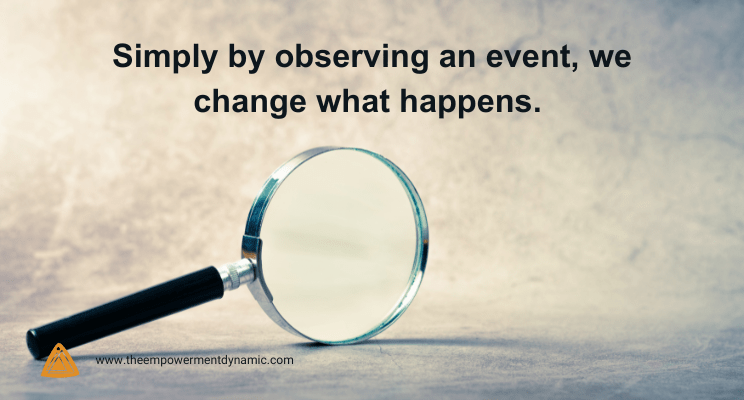
Simply by observing an event, we change what happens. Physics has demonstrated this at the quantum level.
What I see now is that my quality of being when I observe also influences the outcome, for the participants and myself. Even silent and on the sideline, I can choose to Witness with love.
Copyright 2024 Lynn Thorsell