
Self-Awareness Without Compassion is Warfare
A colleague once said: “Oh, the curse of self-awareness. Sometimes it’s easier to not know the reasons why I do things and just go blindly through life.”Sometimes blindness is wonderful, because waking up and becoming…
A colleague once said: “Oh, the curse of self-awareness. Sometimes it’s easier to not know the reasons why I do things and just go blindly through life.”Sometimes blindness is wonderful, because waking up and becoming more self-aware can be a stressful journey.
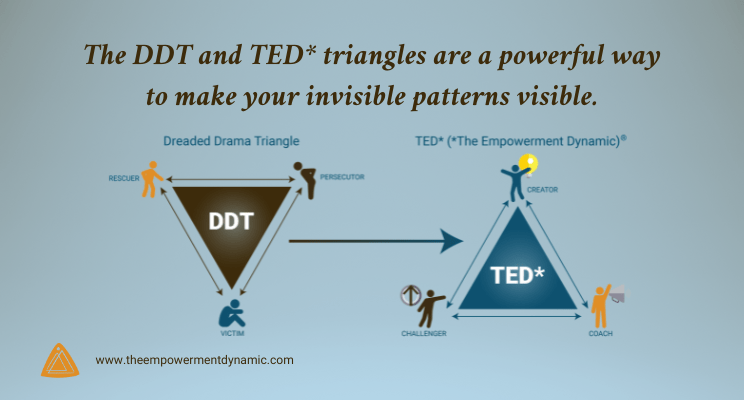
Learning about the shift from the Dreaded Drama Triangle (DDT) to TED* (*The Empowerment Dynamic)® can deepen self-awareness at first. However, sometimes more self-awareness can activate your inner-Persecutor, criticizing you for not living a drama free life. The DDT and TED* triangles are a powerful way to make your invisible patterns visible.
But sometimes you may not want to make your invisible drama patterns visible and would rather keep them underground. If only all of life could be blissful and drama free. The journey of self-awareness is supposed to be full of goodness and light, isn’t it?
Not always! That is why self-awareness without compassion can be personal warfare.
Learning to grow and develop requires new insights, which is the gift of being human. We’re the only species, though, that can become self-critical about our human qualities. Think about it. Birds don’t self-reflect about being birds or how they fly. Fish don’t think about how they breathe and swim under water.
The benefit of being self-aware is that you can reflect on who you are and who you want to be. You can plan ahead, create options, evaluate your progress, adjust and make better choices as you learn. Personal awareness can also conjure up self-criticism, ruminating on the past, what you could have said or done, or worrying about the future.
Becoming more self-aware is a recent phenomenon in the evolution of human consciousness. Medieval kings, priests, and tribal chiefs governed with an iron hand and, if people didn’t listen or questioned their orders, they weren’t alive very long.
Responding to the innate desire to be independent and free, modern society and governing systems have evolved in many parts of the world. This new freedom can liberate you from your self-imposed tyranny of self-criticism and reactive drama if—and it is a big if—you can give yourself a break and have a little self-compassion. Otherwise, the waking up journey is fraught with more stress and may work against your learning and growth.
When David learned about the Karpman Drama Triangle many years ago and realized he had been living his life from the Victim mentality, he asked: “I don’t want to live from a Victim stance anymore, but what is the alternative?”It is with that question and painful moment that he began the journey of self-awareness that revealed an alternate triangle, TED*, with its more resourceful and effective ways of living.
Self-compassion is your essential companion when waking up from one’s Victim mentality. Compassion is an emotion that arises when one see’s another’s suffering and feels motivated to support them. Self-compassion means treating yourself with the same kindness and care that you would extend to another.
When you notice your inner-Persecutor emerge, and it hurls insulting comments your way, allow your Creator essence to open your arms to that part of you. Embrace, with love and compassion, the part that is hurt or criticizing yourself with harsh comments.
The compassion that you would show to anyone in pain is the boost that will ignite your inner Creator when you give that same dose of compassion to yourself.
Becoming more self-aware is not a pain-free journey. Your inner-Creator wants to learn from your stumbles and setbacks to calm your inner-Persecutor. Your Creator essence will emerge, with more power and strength, when self-compassion is present.