Face It—You Cannot Change Other People
The first question many people ask after learning about the shift from drama to TED* (*The Empowerment Dynamic) ® is, “These ideas are so helpful. How do I get other people to change?”There’s often a collective groan…
The first question many people ask after learning about the shift from drama to TED* (*The Empowerment Dynamic)® is, “These ideas are so helpful. How do I get other people to change?”There’s often a collective groan from participants when they hear, “You cannot force others to make ‘shifts happen’ in their own lives!”It is obvious that one person cannot force another person to change, so why is it such a common desire? There are several reasons. You may:
- Genuinely feel, and think, you know what is best for the other person.
- Resist that a relationship isn’t working, so you tell yourself: “I will try one more time to change my husband, or girlfriend, or boss, or…”
- Feel it is easier to ask others to change, rather than change yourself.
- Deceive yourself that you are in control, rather than face the hard truth that you have no power over another person.
All this boils down to the fact that, in many situations, it may be easier to wish and hope that you can change others instead of taking responsibility for your own habits of thought and behavior.
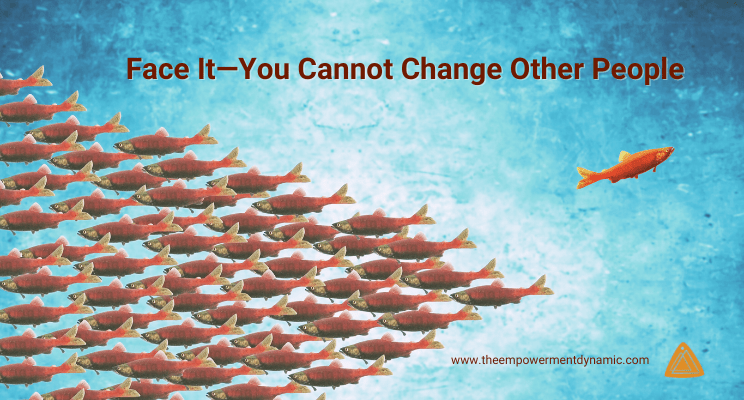
Again, you cannot change other people! You can only change your response to other people and situations. What you can be is a model for your highest and best self by taking responsibility for your own actions rather than projecting onto others what you wish they would change.
The Victim mentality, which is the central role in the Dreaded Drama Triangle (DDT), is rooted in seeing life as a series of complaints about what you don’t like. This can produce an impulse to focus on external situations and other people as the cause of your suffering, which naturally activates a need to control others and the situation. Your internal talk may be, “If they would only change, I would be happy.”If you look deeply at your desire to change others, you may discover a moment of feeling powerless. The more powerless you feel, the more you may try to change them. And, if you examine your powerlessness, you may see that underneath it all is a fear of not having control—even a resentment that you are not in control!
What you can control and accept is your true essence as a Creator—the foundation of TED*. Your Creator essence is your universal, eternal goodness that is your true self. Once you fully realize this truth for yourself, the epiphany emerges that all other people are also Creators imbued with their Creator essence.
Even though you may see yourself as truly trying to help others (the Rescuer role in the DDT), underneath there may be a story you are telling yourself that other people aren’t okay, you know better and, therefore, they should listen to you. This is a form of pride that you may have disguised as a helpful attitude and a justification to fix others.
What’s left for you, once you face the truth that you cannot change other people? To trust them and trust that they ultimately have the power and wisdom to guide their own lives. That can be very difficult when you have judged someone as wrong or in need of fixing.
Accepting your Creator essence and taking responsibility for your actions, life will still be challenging. Now, however, you can let go of your desire to change others. You can trust the truth that all others are also Creators. This acknowledgment will soften your need to control.
The paradoxical mystery is that as you model acceptance and acknowledge other’s Creator essence, they too may choose to change.