

How to Give Feedback and Avoid Being a Persecutor
Are You Trying to Help — or Trying to Control?
One of the most challenging skills in any relationship, whether at work, at home, or in our communities, is giving honest feedback. Most of us have experienced the discomfort – I know I have -- of wanting to say something important while also worrying about how the other person will receive it.
Since my default way of entering the Drama Triangle is through the Rescuer role, I tell myself, “I’m just trying to help.” Yet, even with my best intentions, my feedback can sometimes be experienced as criticism, judgment, or an attempt to control. Before I know it, the other person becomes defensive, and the conversation I had hoped would create learning and growth turns into more friction.
In the language of TED* (*The Empowerment Dynamic®) framework, this is the risk of slipping into the Persecutor role.
The Persecutor does not always show up as an angry, demanding, or aggressive person. Sometimes the Persecutor appears as the person who is certain they know what is best for someone else and resorts to control to be helpful. It can be the part of us that believes, “If they would just take my advice, everything would be better.”
That intention can turn feedback into unconscious (and sometimes conscious!) judgment of the other.
The shift begins by remembering a simple truth that David Emerald, the originator of TED* often said: “We cannot make shifts happen for other people. We cannot control whether someone accepts our feedback, sees what we see, or chooses to change.”
When we forget this, we may unintentionally approach another person as though they are a problem to be fixed rather than a Creator who can learn and choose in their own right.
The antidote is to shift from Persecutor to Challenger.
A Challenger tells the truth while holding others as capable, resourceful, and whole. A Challenger does not avoid difficult conversations. In fact, avoiding honesty can be another form of friction because resentment quietly builds.
The difference is the mindset you bring. The questions shown below help you get honest about your motivation for giving feedback.
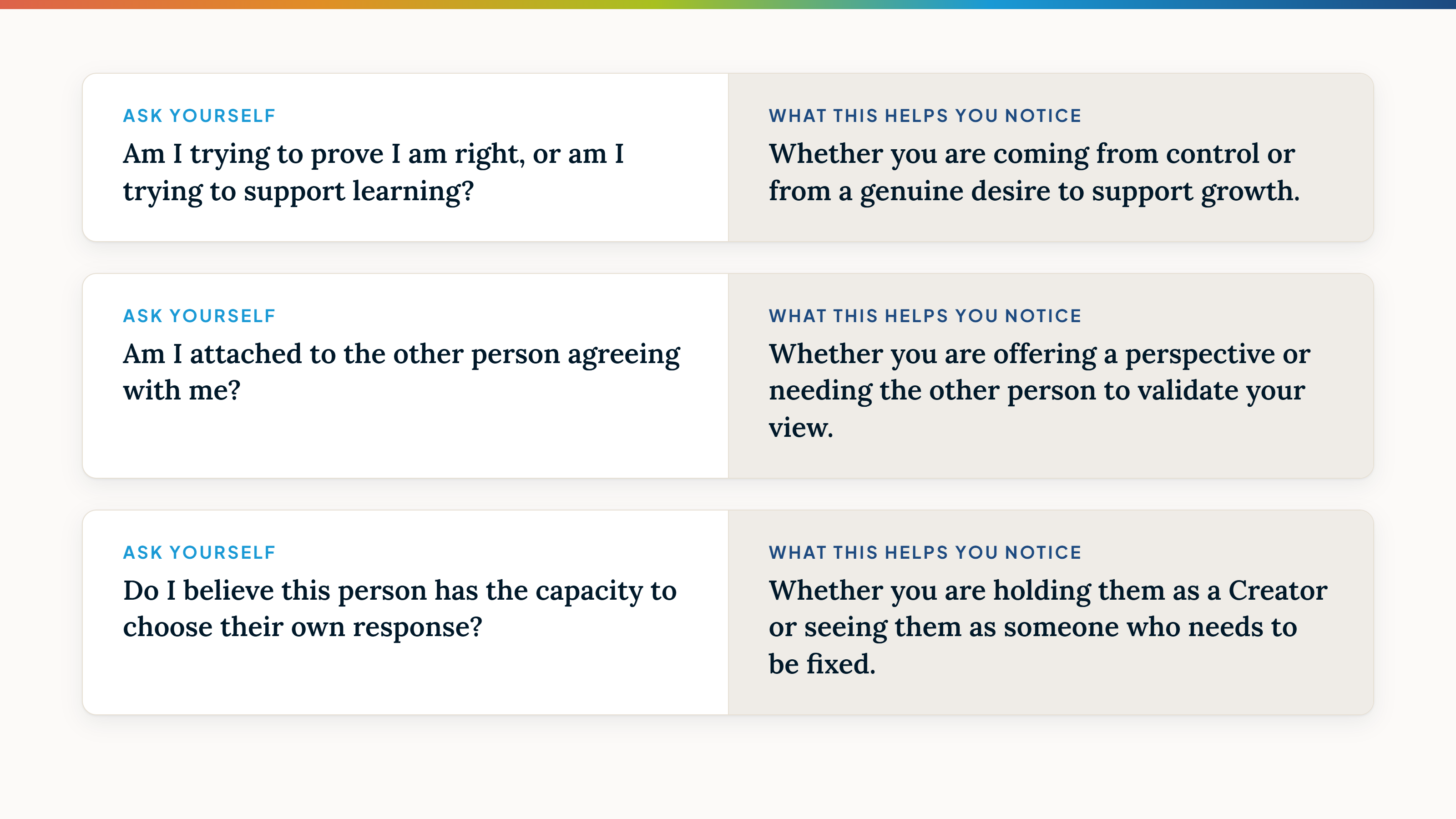
The difference is changing your focus and language from control to curiosity.
Here are a few more suggestions for shifting your language from the point of view of a Persecutor role to your Challenger essence.
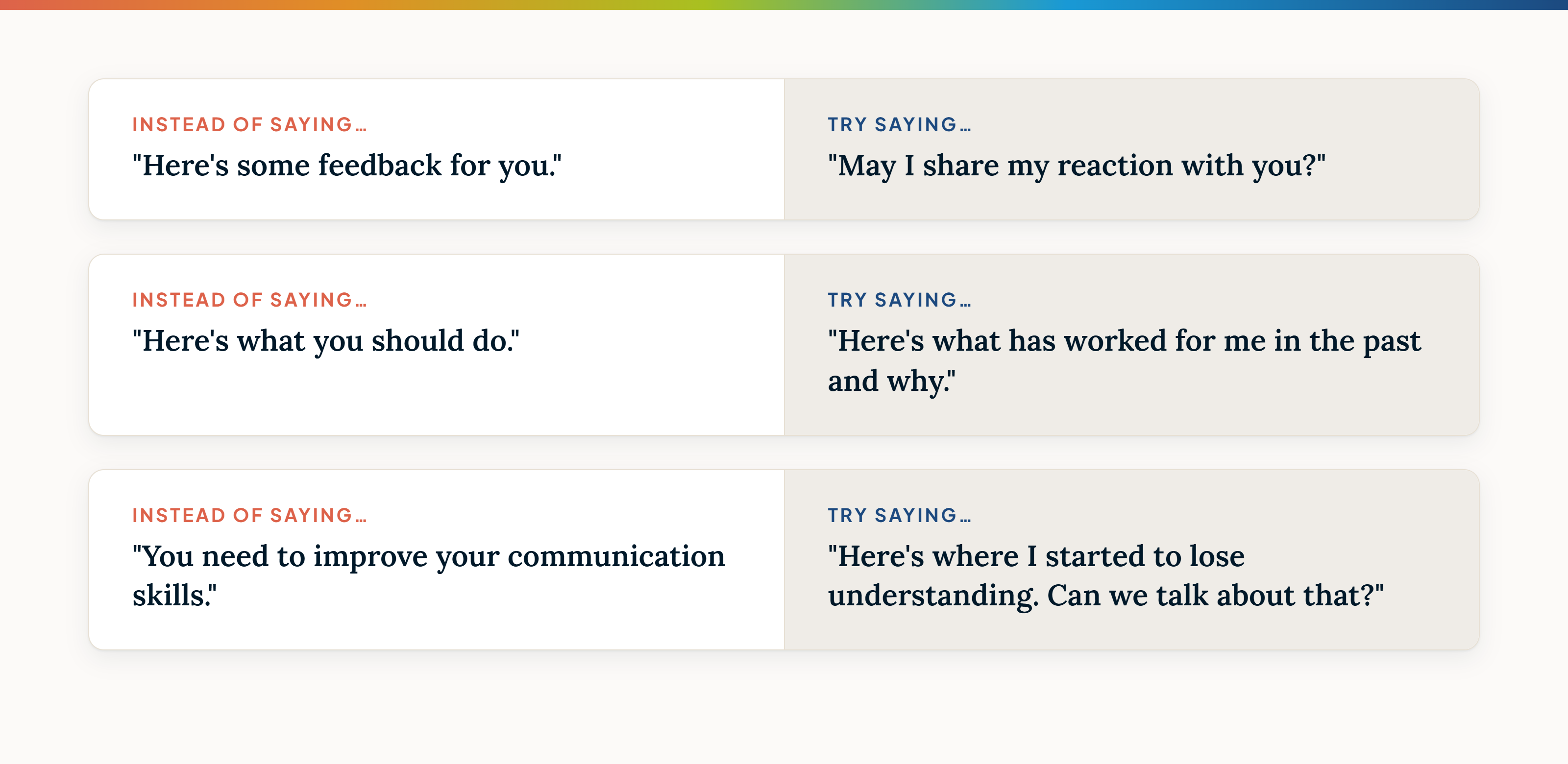
The focus moves away from seeing the person as wrong and exploring the situation together.
A Challenger also understands that “good job” is not always helpful feedback. While it sounds positive, it often says very little about what actually worked. A more empowering response that supports self-discovery and insight:
“I really appreciated what you did. What was going through your mind when you made that choice?”
Now the other person can reveal and own their own wisdom. This is especially important for leaders, coaches, parents, and anyone who naturally wants to support others to grow. The more your identity is invested in someone else’s success, the easier it is to cross the invisible line from supporting to controlling.
The hidden assumption underneath the Persecutor role when giving feedback is often: “I know what needs to happen here. I know how they need to change.”
The Challenger mindset for sharing feedback says: “I have a perspective to offer, and together we may discover something neither of us saw before.”
There is humility in being a Challenger. We accept that our view is incomplete. We acknowledge that we do not always know what we don’t know. This does not mean we withhold our wisdom, experience, or observations. It means we offer them without attachment. We tell the truth and release the need to manage how the other person receives it.
I know this is the most difficult part for me. When I am invested in my point of view, letting go and listening to their perspective is not easy for me yet it is important and I continue to practice.
The next time you have feedback to give, notice your intention before you speak. Are you trying to correct someone, or are you creating the conditions for growth?
The shifts are from judgment to curiosity, from control to partnership and from Persecutor to Challenger.
And that shift may be the greatest feedback gift you can offer another person.
Until next time, here’s to the Creator in you,
Donna
Please join us for this free webinar coming next month.
Click the image to register!