
Going to the Balcony
As you read this blog, pause for a moment, and observe yourself. Where are you sitting or standing? How are you feeling (mad, glad, sad, excited, etc.)? How are you reacting to this unusual start to the blog? Do you want…
As you read this blog, pause for a moment, and observe yourself. Where are you sitting or standing? How are you feeling (mad, glad, sad, excited, etc.)? How are you reacting to this unusual start to the blog? Do you want to continue reading or close it down and move on?
If you paused and reflected upon these questions, you just experienced what Harvard University professors Richard Heifetz and Marty Linksy coined, “going to the balcony.”When you can observe yourself in the moment, you become both the one you are observing and the observer, which quickly broadens your perspective. The value of broadening your perspective is that you become less attached to your drama-filled behaviors or emotions. In short, you become less self-focused and more self-reflective.
Imagine you are in a theatre watching a play from the front row. Your view is so narrow that you can only see the actors directly in front of you. You are so close to the characters that it feels like you are in the play itself, personally enmeshed with the actors. When mired in the Dreaded Drama Triangle (DDT) and its role of Victim, Persecutor, and Rescuer, it can feel like you are sitting in the first row of a drama, unable to see another perspective.
Now imagine that you are on the theater balcony looking over the activity taking place on the stage. This new balcony view provides a wider perspective and you can see things you could not see from the front row. From this vantage point you see the drama playing out but you are not so close that you feel like you are one of the characters in the play.
Moving your perspective from the front row to the balcony is a metaphorical shift out of the Victim script that says life happens to you. As a Creator, the central role in TED* (*The Empowerment Dynamic)® your viewpoint changes. You can step back from your reactivity and get curious about the larger plot that is unfolding. You realize you have the power to write your own life script!
You may feel relieved and more inspired by your ability to see and understand the larger situation and the dynamics that are playing out. With greater understanding it is easier to remain calm and gain new insight into whatever is going on, even if you are involved in the “play” taking place on the stage of life.
From this higher vantage point, you are more likely to pause and connect with others as Co-Creators. This allows you to focus on what you want and on what you can learn from the drama situation. It also allows you to choose a more empowering response and relate from any of the TED* roles of Creator, Challenger, and Coach.
Going to the balcony may take many forms. Pausing and sitting quietly, going for a walk, brewing a fresh cup of coffee, or listening to your favorite music are all ways to break the trance of a narrow perspective. You can, at any time, simply go to the balcony in your mind and feel the larger outlook arising.
The next time you find yourself hooked by drama patterns, take an intermission and go to the balcony. From this vantage point you may spot new information, receive wise guidance or gain insights you hadn’t seen when sitting in the front row. The perspective you gain will help you choose a resourceful and resilient response to the situation.
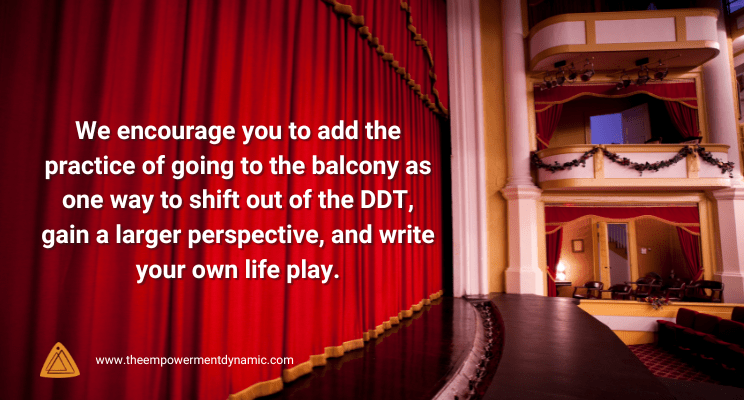
We encourage you to add the practice of going to the balcony as one way to shift out of the DDT, gain a larger perspective, and write your own life play.