
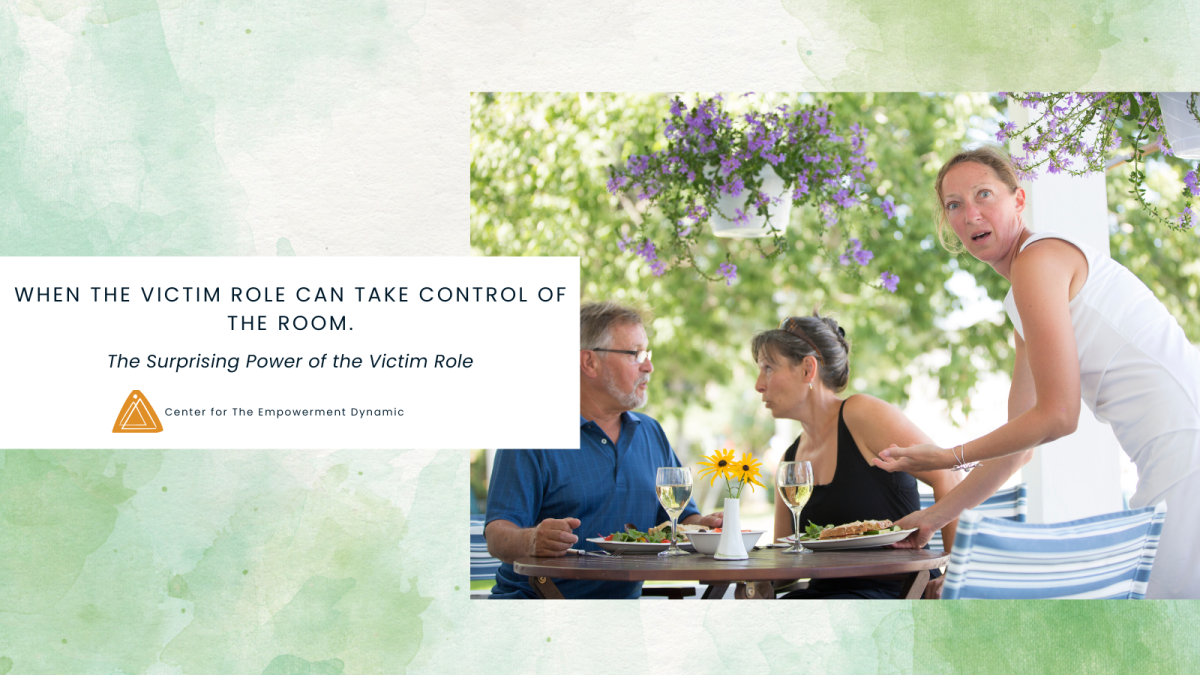
When the Victim Role Can Take Control of the Room
The Surprising Power of the Victim Role I had a recent experience and noticed something surprising and more nuanced about the Victim role than I had seen before. I was at a retreat, staying in a community center with…
The Surprising Power of the Victim Role
I had a recent experience and noticed something surprising and more nuanced about the Victim role than I had seen before.
I was at a retreat, staying in a community center with several dozen people. The meeting room—used for yoga, meals, and group gatherings—was near one woman’s room. Shortly after arriving, she made it clear she had chosen this retreat for peace and quiet. At breakfast one morning, she stood up and announced that the mealtimes were too loud, the noise from the community room disturbed her, and she wanted the breakfast hours reduced. She demanded that activity in the community space be limited, especially in the mornings.
Her announcement was forceful, even angry. People quickly apologized, and some suggested limiting meals or canceling community offerings to accommodate her request. One person even offered to switch rooms with her. She declined, saying she liked her room and didn’t want to move. Over several days, the group made numerous changes to meet her demands.
Watching this unfold, I sensed she was firmly in the Victim role. She had dreamed of a quiet retreat, but reality didn’t match her expectations. She may have seen this as personally disempowering, yet in her “powerlessness” she exerted control over the whole group. Instead of being one disgruntled individual, her complaints redirected the energy of the entire retreat.
As a result, I saw at least five clear responses ripple through the community:
- Apology. Some people immediately apologized, eager to please her.
- Worry. Conversations revolved around, “What will she think?” People wanted to avoid her anger and judgment, not wanting conflict.
- Withdrawal. Some skipped programs to “keep the peace.”
- Frustration. Many felt disappointment and resentment because their own experience was being overshadowed.
- Confusion. The group didn’t know how to respond as her complaints dominated daily conversations. Their focus was on what they didn’t want (to upset the one complaining) rather than on the community experience they desired.
What I had always described as powerlessness was, in fact, a form of taking power. Playing the Victim card gave her control of the room and in this case managed to direct the focus on the retreat for more than two days. This is the hidden power of those that play the Victim role.
At first, I thought she may be more aligned with the Persecutor role in the Drama Triangle because some at the retreat saw her as a Persecutor in the Drama Triangle. But clearly, she saw herself as a Victim, and the noise was the problem—her Persecutor.
The paradox of the Victim role is striking. On the surface, the Victim appears powerless—helpless, at the mercy of others, with no choice but to suffer. Yet underneath, this very posture becomes a way to manipulate and control. By drawing attention to their unmet needs, the person playing the Victim role quietly orchestrates the energy of the group. Others scramble to appease, avoid conflict, or change plans, giving the Victim the very power they claim not to have. What looks like weakness is, in fact, a subtle form of dominance. Powerlessness becomes a way that draws others into the unmet needs of the one playing out the Victim role.
Do you see yourself in this story and description? We all have experienced feeling like a Victim. Once we notice the dynamic, we can become more self-aware of our own behavior.
When someone else is entrenched in the Victim role, an important first step is not to argue or dismiss them. That only escalates the dynamic. Instead, I offer these approaches that can support everyone:
- Listen. Acknowledge the feelings and concerns of someone who is behaving like a Victim. Telling someone, “You’re just acting like a Victim” only deepens their resentment. While this never happened overtly at the retreat, there were a few people whose energy was condescending.
- Inquire. Explore the situation. What’s the real scope of the concern? Is there a story behind the complaint that needs to be voiced and dealt with?
- Offer options. Propose practical solutions, like the room switch in this case, or minor adjustments that might work for everyone.
- Stay grounded. Don’t get pulled into the Victim’s story. It is not the event itself that calls for attention. It is the Victim’s identity with the role, and the subsequent actions being played out that form the root cause of the conflict.
- Return to the group’s purpose: What are we here for? What outcomes do we want?
Once these steps are taken, the person in the Victim role has a choice. They can continue to complain and feel like a Victim, or they can adjust. Either way, the group has set boundaries and returned the focus to its shared purpose.
This experience showed me a deeper truth: when we enter the Drama Triangle through the Victim role, we may feel powerless, but often we are wielding control. By drawing everyone’s focus to our unmet needs, we shift the energy of the room, the family or relationship. It may not look like control in the usual sense, but it is a powerful dynamic. Left unexamined, one person’s Victim stance can greatly impact the behavior of many.
Please share your insights about the Victim role; when you may have played the Victim card, or how you may get drawn into the Victim story. What have you learned?