We'll See
One thing has become abundantly clear these last few years – life is uncertain. Human beings are the only species that can imagine a future, which can serve you well when planning and creating a general direction for…
One thing has become abundantly clear these last few years – life is uncertain.
Human beings are the only species that can imagine a future, which can serve you well when planning and creating a general direction for your life.
Trying to predict the future is also one way to manage your uncomfortable feelings about a stressful present moment. You, like so many people, may project a story about the future to ease a worry you have about what is happening today. But do you really know how things will turn out?
There is a popular Chinese parable that sheds light on this question.
A farmer and his son had a beloved stallion who helped the family earn a living. One day, the horse ran away, and their neighbors exclaimed, “Your horse ran away, what terrible luck!” The farmer replied, “Maybe so, maybe not. We’ll see.”
A few days later, the horse returned home, leading a few wild mares back to the farm as well. The neighbors shouted out, “Your horse has returned, and brought several horses home with him. What great luck!” The farmer replied, “Maybe so, maybe not. We’ll see.”
Later that week, the farmer’s son was trying to break one of the mares and she threw him to the ground, breaking his leg. The villagers cried, “Your son broke his leg, what terrible luck!” The farmer replied, “Maybe so, maybe not. We’ll see.”
A few weeks later, soldiers from the national army marched through town, recruiting all the able-bodied boys for the army. They did not take the farmer’s son, still recovering from his injury. Friends shouted, “Your boy is spared, what tremendous luck!” To which the farmer replied, “Maybe so, maybe not. We’ll see.”
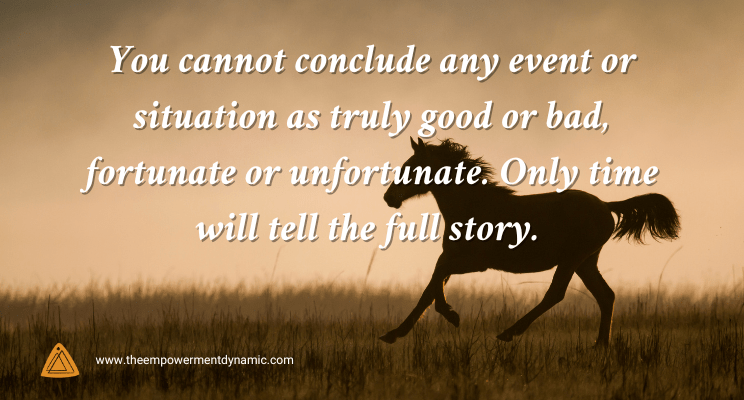
The fable’s teaching is that you cannot conclude any event or situation as truly good or bad, fortunate or unfortunate. Only time will tell the full story.
Concluding that you know how the future will turn out sets you up for disappointment and feeling like a Victim to what you thought you knew as true. Attaching yourself to a future story, especially a story that attempts to escape the anxiety you may have about the present moment, can cause additional worry when things keep changing so fast.
Trying to create a certain future sometimes feels more comforting if the present is stressful or overwhelming. Especially in times like these where the stakes are high, you may try to convince yourself that you know what the future holds.
The wiser approach is to take the “we’ll see” perspective, as the farmer did, not concluding that you know exactly what is good or bad. Rather than judging things as good or bad, you might adopt the mantra: “It will be interesting to see what happens.”You can still live aligned with your values and what matters to you. You can still be a spokesperson for your truth while holding lightly that you do not know how things will turn out.
There is no way to know precisely what the future holds or whether one event will lead to a predictable future. With new technologies like artificial intelligence accelerating the rate of change, it will make it even harder to predict the future.
It may be unsettling to admit that you have no power to know the future. For others, it is liberating to not know, and decide instead to embrace life by taking one baby step at a time.
Either way, like the farmer in the Chinese fable, you can live your life and move forward with an enlightened, “We’ll see.”