
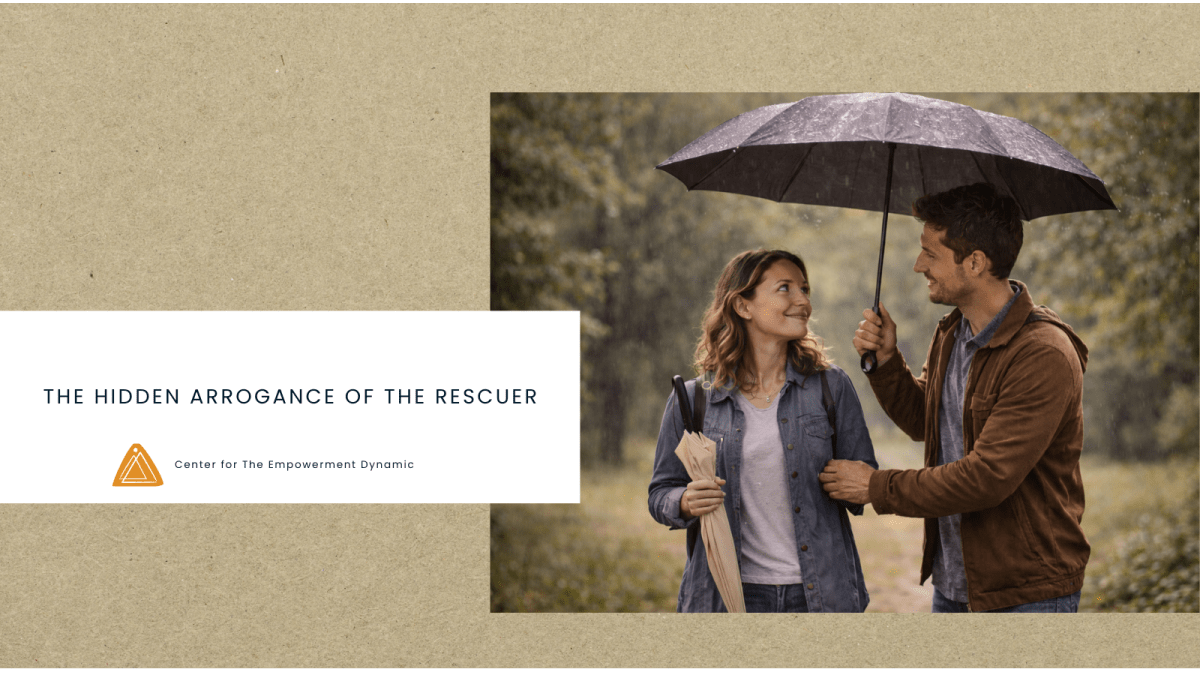
The Hidden Arrogance of the Rescuer
Thank you to those who have subscribed to our new Creator Community. Our first live call together was powerful and insightful. Join our community and the live session with Donna on Thursday, Feb 5 at 8 AM PST. We’ll dig…
Thank you to those who have subscribed to our new Creator Community. Our first live call together was powerful and insightful.Join our community and the live session with Donna on Thursday, Feb 5 at 8 AM PST. We’ll dig deeper into the topic The Hidden Arrogance of the Rescuer. Join the Creator Community HERE
You may be surprised to read the word arrogance associated with the Rescuer role.
I think arrogance is probably the last word most people who identify with the Rescuer role – me included – would use to describe ourselves. Our identity is that we care about other people and want to help smooth over, fix, and make life easier for those around us. On the surface, relating from the Rescuer role looks generous and selfless.
So, what could this possibly have to do with arrogance?
Quite a lot, as it turns out.
The arrogance of the Rescuer is not loud or obvious. It doesn’t announce itself as pride or superiority. It hides behind good intentions. It sounds like responsibility and that’s why it’s so hard to see.
At its core, the Rescuer role is built on an unexamined assumption: I know better than you what you need right now. Not because we intend harm but because we quietly and often unconsciously doubt the other person’s capacity to handle things on their own.
This is the hidden arrogance.
Once we see this, rescuing begins to look less like kindness and more like control— a well-intended, often unconscious, and deeply human pattern of control.
I had always thought of myself as helpful and caring, someone who noticed what needed to be done and stepped in to take care of things. I often saw quickly what would work and had plenty of ideas about how to move things forward.
My helping wasn’t neutral. It came from a sense of knowing better.
As I explored this more deeply, I learned that the root of the word arrogance comes from Latin, meaning to assume. And I learned there are many forms of arrogance.
The most familiar form is the obvious one—the nose-in-the-air superiority that looks down on others. That was my definition of arrogance, and I resisted using the word to describe myself.
But then I learned about another form, sometimes called “helper arrogance.” It shows up as having the answers, giving advice, stepping in or assuming responsibility. Now looking back, as a recovering Rescuer, I recognize this helper arrogance pattern well.
My intention was to help. And yet, the impact was often patronizing and unknowingly dismissive of other’s capacity. When I saw this clearly, I was broken-hearted to realize that my deep desire to be helpful was also a subtle form of superiority.
The Rescuer doesn’t experience themselves as arrogant. Quite the opposite. Rescuers see ourselves as kind, responsible, and caring. That’s why this realization can be so shocking. What I didn’t want to admit was that this was a form of control.
Rescuing allowed me to manage outcomes and relieve my own anxiety. It allowed me to feel useful and needed. And if I’m honest, it allowed me to feel a quiet sense of superiority—not out loud, but internally: I’ve got this. You don’t. That is the arrogance of the Rescuer.
Two questions have become essential for me to ask myself when I notice I’m caught in the Rescuer role….again!
- How do I truly see the other person? Capable or fragile? Resourceful or dependent? Whole or needing me?
- What might become possible if I trusted this person’s capacity as much as I trust my own?
This is the shift from Rescuer to Coach in The Empowerment Dynamic®. Not helping less but trusting more. Not stepping away but stepping back.
- The Coach does not assume they know better. This humility is the antidote to the Rescuer who “knows best.”
- The Coach doesn’t rush in to fix. They are patient and can hold silence as the other person ponders what theirs is to do.
- The Coach holds faith in another person’s ability to learn, choose, and create.
If you recognize yourself here, be gentle. Rescuing is not a character flaw. It is a learned survival strategy in a world that rewards over-functioning and control. But awareness gives us choice.
Helpers are often rewarded and praised, which makes the Rescuer role especially difficult to shift. Yet the moment we truly see others as capable Creators of their own lives, something softens. Control loosens. And our hidden arrogance settles.
Do you resonate with this insight? I welcome your reflections and insights under comments.
Until next time, here’s to the Creator in you.
Donna