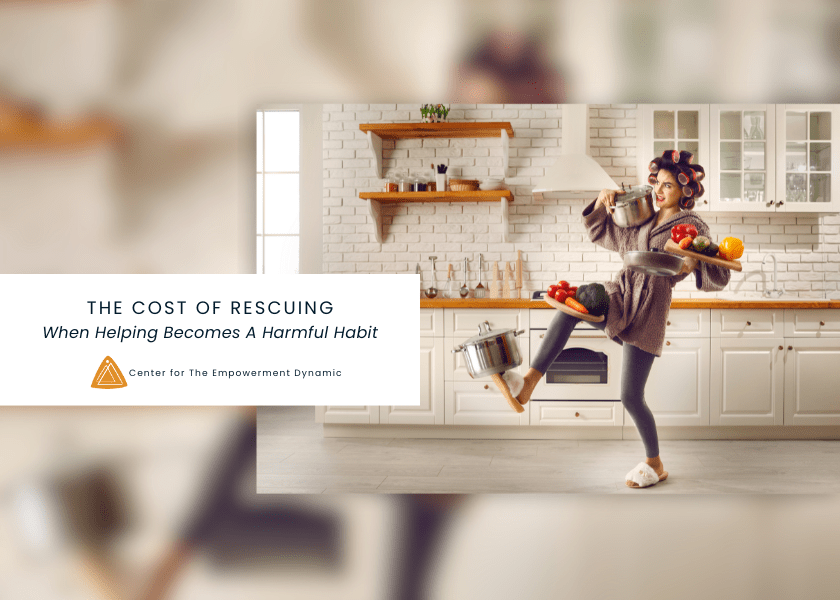
The Cost of Rescuing
By Donna Zajonc with David Emerald People often tell me that the Rescuer is the “best” role in the Dreaded Drama Triangle (DDT) because it’s the helpful one—the one that steps in, fixes the problem, and saves the day.…
By Donna Zajonc with David Emerald
People often tell me that the Rescuer is the “best” role in the Dreaded Drama Triangle (DDT) because it’s the helpful one—the one that steps in, fixes the problem, and saves the day.
Generosity and helpfulness are beautiful human qualities. However, they can become costly strategies for staying in control and managing messy situations.
Most people don’t consciously choose the role of Rescuer. It often begins as a coping strategy developed from early experiences, where “going along to get along” and taking care of others felt like the only way to earn love and safety.
Here are a few characteristics that describe the Rescuer role. See if you identify with any:
- Your self-worth and identity are tied to being helpful.
- You’d rather avoid personal pain or vulnerability than face conflict.
- You take on more work or duties, even when others are responsible.
- There’s always some crisis needing your help.
- You feel as though you’ve let others down—or that they may reject you—if you can’t fix their problems.
- You like feeling indispensable, even while struggling to meet your own needs.
I recently wrote a blog on the subtle nature of Victim thinking. Rescuer thinking can also be subtle and easily overlooked because it often stems from a sincere desire to help. But when rescuing becomes a habit, it traps you in a reactive loop.
In my workshops and coaching courses, I ask participants if they experience costs when they're in the Rescuer role. Emotional exhaustion and burnout are always at the top of the list. They also report:
- “When I’m always focused on other people, I rarely ask for what I need—and eventually, I don’t even know what I want.”
- “I end up feeling resentful because I say yes when I don’t really want to.”
- “I often wonder if I even have a purpose if people don’t need me.”
- “I end up feeling angry when people don’t take my advice.”
Then I ask a follow-up question: “What are the costs to others?” Some of the responses I’ve received include:
- “My overdoing for others reduces their resourcefulness, inadvertently disempowering them.”
- “When I over-function, I unconsciously give others permission to under-function, keeping us both trapped in the DDT.”
- “Sometimes I smooth things over too quickly and may prevent important disagreements that could lead to growth and clarity.”
- “I realize now I may be disrespectful to others, implying they can’t manage their own affairs.”
Given these psychological patterns—and society’s approval of people who are helpful—it’s no surprise that transforming the Rescuer role is not easy.
If you don’t identify with the Rescuer role, you may not fully understand the strong need to please that those who do experience. However, it’s likely that someone in your life does identify with this role. Compassion and understanding of what they are facing is important.The shift from Rescuer to Coach, in TED* (The Empowerment Dynamic)®, is a powerful one. A Coach holds space. They ask questions instead of giving answers. They trust that others are capable of finding their own solutions. They support without taking over.
This shift begins with self-awareness and insight into the costs of Rescuing. Here are some reflective questions to consider:
- Am I helping because they need it—or because I need to feel needed?
- What am I avoiding in myself by focusing on others?
- What would support look like if it included trust, not control?
The Rescuer’s heart is good. But if you strongly identify with the Rescuer’s habits, it can become a costly cage for you, and for those you love.
Here’s the Rescuer’s dilemma: until you heal your attachment to others’ approval, you will never fully own your authentic voice.
Does this post resonate with you? Please share your experience in the comments section.
Until next time, here’s to the Creator in you!Donna