Navigating Difficult Conversations with The Empowerment Dynamic
Who do you want to be when you are in difficult conversations?
We are living in a time of deep polarization. Political differences, cultural debates, workplace tensions, family disagreements, and even everyday conversations can quickly become emotionally charged. These difficult conversations often erode trust, divide families and teams, and leave people feeling misunderstood and even hopeless.
Instead of connecting with one another, we dig in and listen in order to win the point rather than deepen the relationship. We prepare our rebuttal, seeing the other person as an opponent.
One of the reasons I appreciate Dr. Stephen Karpman – the originator of the Drama Triangle --is because he describes the three primary patterns that commonly emerge in conflict: Victim, Persecutor, and Rescuer. Imagine how these patterns might sound in a difficult conversation.
The Victim says:
“You never listen to me.”
“There’s no point talking to you.”
“Nothing I say will make any difference.”
The Persecutor says:
“You’re wrong.”
“How can you possibly believe that?”
“People like you are the problem.”
The Rescuer says:
“I just want everyone to be happy.”
“Maybe I should just give in.”
“I’ll do what it takes to keep the peace.”
Here is the painful paradox: all people in the disagreement may feel like the Victim while seeing others as the Persecutor. Each person sincerely believes others are causing all the problems.
From there, polarization deepens. We search for people, news sources, leaders, or communities that validate our position and who can be our Rescuer, reassuring us that we are right and the other side is wrong.
So, who wins? Usually, no one.
The gift of recognizing the Drama Triangle patterns is that it gives us a way to see our own reactivity. These roles do not represent the best of who we are. They are patterns we can fall into when we feel threatened, powerless, or convinced that someone else must change.
TED* (The Empowerment Dynamic)® offers another path. It offers a framework for shifting the energy of a difficult conversation—from reactivity to greater choice, responsibility, and possibility.
Instead of organizing the conversation around who is right, who is wrong, and who is to blame, TED* redirects attention toward very different questions: What do I want to create? What is mine to own? And how can I relate to the other person in a way that supports movement rather than more drama?
That shift matters because what you focus on will affect how you show up. When you are focused on the problem and on what the other person is doing wrong, you are more likely to defend, blame, withdraw, fix, or please. Focusing on a desired outcome allows more opening between what is happening and how you might respond to it.
TED* also changes how we see other people. Rather than casting them as the Persecutor or someone who needs to be fixed, we begin with the assumption that they, too, are a Creator—a human being with the capacity to choose, learn, respond, and take responsibility.
The conflict may still be difficult. The disagreement may remain. But the energy of the conversation changes. We are no longer simply reacting to one another. We have a framework for becoming more intentional about who we want to be and what we want to create together.
The next step may be the most difficult: Accepting that if anything is going to change in the conversation, you must begin with yourself. Rather than asking, “How can I get them to understand?” ask:
· “How am I showing up right now?”
Then consider another important TED* question:
· Do I see this person as a Creator?
Seeing another person as a Creator does not mean agreeing with them. Nor does it mean tolerating behavior you believe is harmful. It means refusing to reduce them to an enemy, an idiot, or the problem. That shift can fundamentally change the quality of a conversation.
Next, ask yourself: Do I want to connect with this person—or convince them of something?
Sometimes we tell ourselves we want dialogue when what we really want is to be right. We want the other person to see the wisdom of our point of view.
Choosing connection does not mean becoming a wallflower or abandoning our convictions. This is where the TED* Challenger role becomes essential. The Persecutor says, “I’m right and you’re wrong.” The Challenger stands for their truth without needing to diminish the other person.
· “I want to share a different perspective.”
· “The impact this has had on me is…”
· “I want to understand how you arrived at your view.”
And the Coach role brings curiosity. Instead of preparing your next argument while the other person speaks, ask:
· “What matters most to you about this?”
· “What experience shaped your perspective?”
· “Tell me more.”
Perhaps one of the great challenges of our deeply polarized world is learning to stand firmly for what we believe while remaining open to the humanity of people who see things differently.
There will always be disagreement and differences of opinions. The more important question is: Who do I want to be when I’m in difficult conversations?
Until next time, here’s to the Creator in you,
Donna
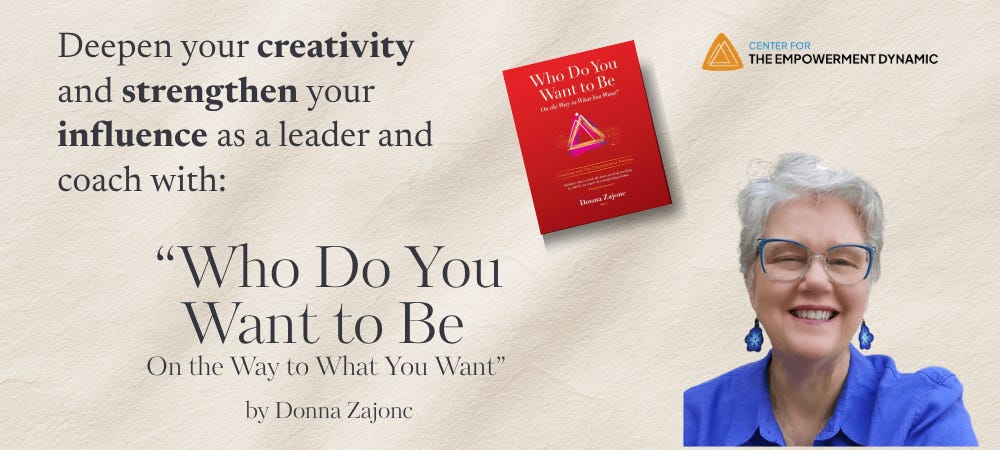
I invite you to learn more about navigating difficult converstations by reading my book "Who Do You Want to Be On the Way to What You Want?”
Click the image below to order!
Visit our website www.theempowermentdynamic.com