Waiting for the Other Shoe to Drop
Have you ever wondered about the origins of the saying “waiting for the other shoe to drop?”It began in the early 1900’s with poorly constructed buildings in the U. S. that had very thin floors and walls. At night,…
Have you ever wondered about the origins of the saying “waiting for the other shoe to drop?”It began in the early 1900’s with poorly constructed buildings in the U.
S. that had very thin floors and walls. At night, tenants would often hear their neighbors above them getting ready for bed. Part of the nighttime ritual included the sound of a shoe hitting the floor as those on the floor above removed a shoe, preparing to bed down. Those below them waited for the next shoe to fall, signaling that the people above were quieting down for the evening, and they could finally enjoy some peace and quiet.
Over time this saying has been interpreted as waiting for an inevitable event to occur, and usually one that has negative consequences.
Both Donna and I (David) grew up with parents who were children during World War II and the Great Depression. This was a time of great uncertainty, war, and hardship for many. One of my parents was especially traumatized by those early life experiences, which instilled a mindset of worry and fear in my family. No matter how good things were, our family was constantly on edge waiting for the other shoe to drop.
We now know that inter-generational trauma is real and can be passed down to the next generation. I am still sensitive to what may go wrong, waiting for the other shoe to drop. At the same time, I feel my childhood experiences have helped me to be more sensitive toward those who have faced similar and even more terrible trauma-filled experiences.
It seems today that there is no end to the long list of the latest bad news. The list of collective traumas is so long right now that we hardly have room to list all the distress ripping through our world. It’s only natural that waiting for the other shoe to drop is how we may be feeling.
Yet, even in the face of these challenges, we have a choice as to how we respond. That choice resides in the first of the 3 Vital Questions, which is: “Where are you putting your focus?”Waiting for the other shoe to drop—the next unexpected event—rises from the problem-focused and fear-based Victim mindset. When this is your internal operating system, you may scan the environment for early warnings signs that things are about to turn in a negative direction. This mindset sets you up to react with some combination of fight, flight, freeze, or appease behavior.
If you, too, learned to wait for the other shoe to drop when growing up, the good news is that it does not have to be how you are as an adult. Early childhood anxieties, while they affect you, do not have to be your inheritance. Gradually you can see that you have a choice about how to respond to life’s many challenges.
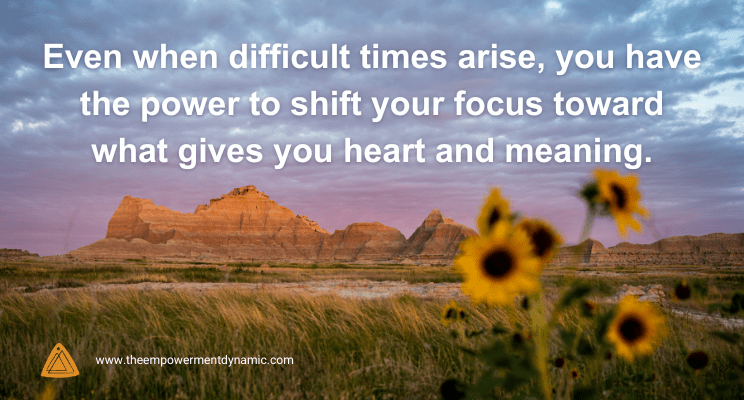
The reality of the human experience is that there will always be another shoe that will eventually “drop” in your life, whether at home, work, or as global events. Even when difficult times arise, you have the power to shift your focus toward what gives you heart and meaning.
From this Creator mindset, you have a greater chance of taking things in stride when the next “shoe” drops. You may still experience surprise and shock or a wide range of difficult feelings. However, as a Creator, you have the capacity to pause and choose how to respond.
So, rather than waiting for the next shoe to drop, harness the outcome-focused and positive emotion-based resources of a Creator mindset and choose how you want to move forward.