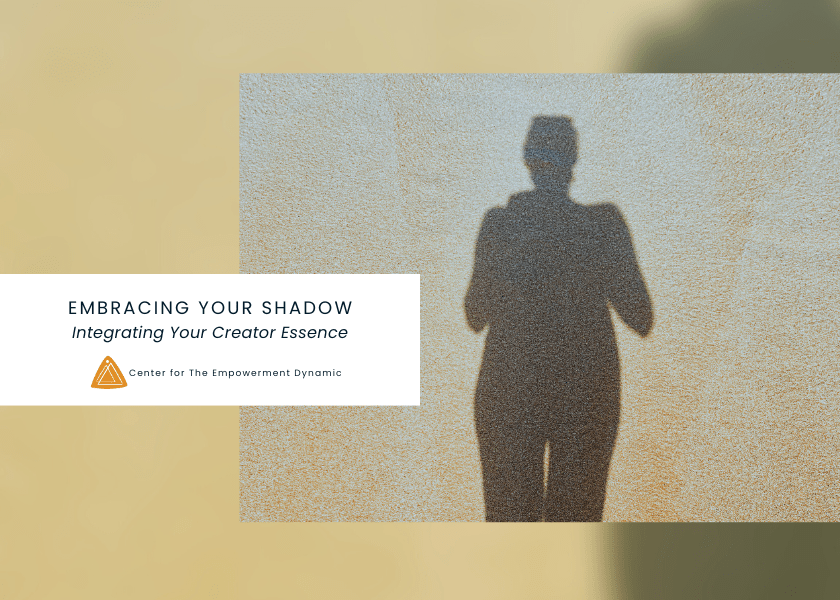
Embracing Your Shadow: Moving from Resistance to Integrating the Creator Essence
By Donna ZajoncWhile I’m not a psychologist, I’ve followed Carl Jung’s brilliant work for many years. What I appreciate most about his teachings is how clearly he named the “shadow” within us—the unconscious, often…
By Donna ZajoncWhile I’m not a psychologist, I’ve followed Carl Jung’s brilliant work for many years. What I appreciate most about his teachings is how clearly he named the “shadow” within us—the unconscious, often disowned parts of our personality that the ego resists seeing, acknowledging, or accepting. Jung believed that these shadow elements hold not only the darker aspects of our behavior but also hidden gifts, creativity, and deep reservoirs of wisdom waiting to be integrated into our conscious self.
I recently had two dreams that deeply stirred something in me. Both featured an unknown character who was driven to get things right. This person was someone intensely focused on pushing decisions forward, forcing clarity, and refusing to pause. In the dreams, I found myself actively avoiding this person. I didn’t like them. Their energy was urgent, controlling, and impatient. I woke up feeling unsettled, and as I lay in bed reflecting, I asked myself the question I’ve learned to ask when something in a dream feels emotionally charged:“Is there a part of me I don’t want to see?”The answer came swiftly:“Yes, the dream was about a part of me I don’t want to acknowledge.”I knew instantly that the character I was avoiding was an aspect of myself—a shadow part that I often try to deny. I, too, can push and force decisions, especially during times of uncertainty. This side of me becomes activated when life feels ungrounded or out of control. In those moments, my inner “pusher” steps in to take charge, believing that if I just move fast enough or make the right decision, I’ll regain stability. But instead of clarity, my pusher shadow often leaves me feeling more fragmented and exhausted.
That morning, I sat with the discomfort of the dream and the recognition it brought. Over several days I noticed when I was trying to fix or force decisions. When I did notice, I recalled the message in my dream. And in that tender space, something shifted. I felt compassion for the part of me that pushes, strives, and tries to make everything okay. I saw how it developed as a survival strategy—to cope, to protect, to feel useful. But I also saw that this way of being was no longer serving me. What I needed now was to slow down, not make more effort. I needed to pause, to soften, to trust the unfolding of life without rushing to fill in the unknown.
Instead of reacting or suppressing the part of me I didn’t like, I chose to acknowledge it. I thanked it for its loyalty, for always trying to take care of things. I also let it know:“It’s okay to rest now. We don’t need to force this”.
This is the essence of shadow work: to turn toward what we’ve rejected within ourselves, to meet it with curiosity rather than judgment. And ultimately, to welcome it as an important part of us. This is the work of integration and becoming whole. And in doing so, I reconnected with my inner Creator—the aspect of me that trusts, listens, and allows. It knows that clarity will come, not from forcing, but from staying present, patient, and attuned.
The journey from shadow to Creator consciousness is not linear. It is a layered path of revisiting old patterns with new eyes. We are provided with an abundance of ways to spot our shadow so that we can be free and integrate them into who we are as mature human beings.
It doesn’t matter how long you avoid confronting your shadow parts because they will keep appearing in your experience until you pay attention to them. This is one reason I love the Dreaded Drama Triangle because it accelerates our ability to name and see our reactivity habits. Instead of rejecting our reactive roles, we can have a relationship with them and accept aspects of ourselves we may have rejected or disowned.
I spotted one aspect of my shadow from a dream. Here are two other ways to see your shadow:
- Pay attention to what triggers you. Try to see the trigger as a message that something has been buried and wants your attention.
- Notice what you dislike in someone else. We often project our shadow onto others in the form of judgements but are often a mirror for what we don’t like about ourselves.
When you see your shadow part, it is time to slow down and listen to your Creator essence. You are invited to soften the hard edges you’ve built around your identity and to remember that you are not broken—you are becoming.
And so, I will continue to honor my shadow parts that show themselves in my dreams, and in times when I get triggered and judge others. Each time I see a part of me I’d rather avoid I will remind myself that this is my Creator essence showing me a way toward greater wholeness.
I also appreciate hearing from you with a comment or heart. Until next time, here’s to the Creator in you.Donna