Letting Go of the Need to Control
https://theempowermentdynamic.com/wp-content/uploads/2024/09/Control.mp3There is a popular story about a corporate executive who proudly declared to his professional coach that he had learned how to control everything…
https://theempowermentdynamic.com/wp-content/uploads/2024/09/Control.mp3There is a popular story about a corporate executive who proudly declared to his professional coach that he had learned how to control everything that went on in his department. The feeling of being more in control helped him feel more confident.
Sensing that the executive truly believed he had mastered the art of control, his coach asked if he’d ever walked on an ocean beach. When he said yes, his coach asked: "Picture walking on your favorite sandy beach, beautiful ocean waves rushing up toward your bare feet.”"Got it. I know the beach. I can picture it now," he said.
The coach continued. “Now turn and face the waves. With your well-honed ability to control, stop just one of those waves from coming to shore." He looked at her with a frown on his face. "Well, that's ridiculous.""You said that you have a well-honed ability to control."He said, “Okay. Message delivered.”When you use control, it becomes a strategy to manage your environment and what is happening around you. The need to control often arises from feeling fragile about our own self-worth. You may tell yourself that if you can control things “out there,” then your inner self-worth will be strong. This is the ultimate in disempowerment—giving power to external circumstances and other people over which you have no control!
Looking through the lens of the Dreaded Drama Triangle (DDT) roles of Victim, Persecutor, and Rescuer can help you become more aware of your controlling habits. When in the Rescuer role, for example, you fool yourself, thinking that you can solve other people’s problems by being overly pleasing, fixing, and accommodating. You think you are being helpful, but it really is a backhanded way to assert control of others.
In the Persecutor role, you lean against and take control by judging who or what is to blame for what you don’t like. Your assertive behavior might be overt, or you may silently think thoughts about winning, dominating, being right and “one up.” Because most of us feel uncomfortable owning the part of us that plays the Persecutor role, we may become unaware of the clever ways we try to exert control.
When in the Victim role, control can be subtle again because you may not be aware of how you have adopted controlling behavior. While you may feel powerless and think you have no control, it is in giving up your responsibility that you paradoxically become controlling. You insist that you have no power and demand that others or the situation must change before you change. How controlling and maddening to those who live or work with you!
Loosening the universal need to be in control is a life journey. We deceive ourselves when we think we're in control. A friend recently shared seeing a t-shirt that read: “Relax. Nothing is Under Control,” which brought a laugh.
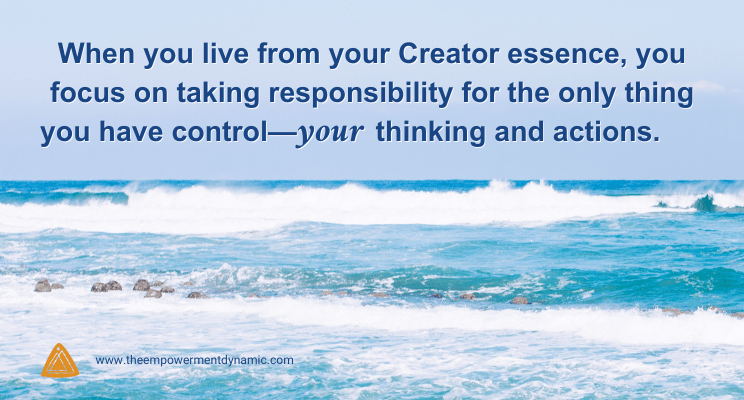
All you can control is your response to life's events. That is why the opposite of Victim is Creator, the foundation of TED* (The Empowerment Dynamic)®. When you live from your Creator essence, you focus on taking responsibility for the only thing you have control—your thinking and actions.
In the week ahead, become more aware of what you can and cannot control. When your need to control arises, stay curious just one more minute. In that minute, realize that whatever you want to control is just a thought, and you can let it go.
And what if you did let it go? Your life would become lighter, more joyful, and an opportunity to choose personal freedom.